
Nova Scotia Duck Tolling Retriever Temperament and Grooming
Table of Contents
- Introduction: The Playful Canadian Tolling Dog
- Breed Handling Profile
- Breed Purpose and Why It Matters for Nova Scotia Duck Tolling Retriever Temperament
- FurHQ Coat Type Breakdown
- Not Sure About Your Dog's Coat Type?
- Puppy Coat to Adult Coat Transition
- The FurHQ 5-Step Grooming Method: Technical Reality
- FurHQ Starter Grooming Kit Breakdown
- Nova Scotia Duck Tolling Retriever Temperament: Superpowers and Kryptonite
- FurHQ's Lifestyle Lens and Pro Insights
- Health and Lifespan: The FurHQ Touch Test
- Related Breed Comparisons
- Related Reading
- The Bottom Line
- Variation Clarity Statement
- FAQs
 Introduction: The Playful Canadian Tolling Dog
Nova Scotia Duck Tolling Retriever Temperament is what happens when a breed developed in Nova Scotia, Canada, to lure waterfowl within gunshot range through playful, enticing movement combines a uniquely fox-like appearance with an intense, driven, yet surprisingly reserved personality.
The Nova Scotia Duck Tolling Retriever, commonly called the Toller, is the smallest retriever breed and the only one developed specifically to toll (lure) ducks by frolicking along the shoreline, piquing the birds' curiosity and drawing them closer. Understanding Nova Scotia Duck Tolling Retriever Temperament starts with this unique hunting method: the breed works through play, movement, and irresistible appeal.
These dogs are intensely playful yet surprisingly reserved. Nova Scotia Duck Tolling Retriever Temperament includes a high play drive, an intense focus during work, a surprisingly reserved demeanour with strangers, and an independence that distinguishes the breed from other, more eagerly affectionate retrievers. The Toller is not a Golden Retriever in a smaller package. It is a distinct breed with a distinct personality.
The feathered long double coat on the Nova Scotia Duck Tolling Retriever is a water-resistant working coat. Nova Scotia Duck Tolling Retriever Temperament and coat care connect because the water-repellent double coat with moderate feathering was designed for cold Canadian waters and sheds significantly during seasonal blow-outs. When the blow-out hits, this is real coat work.

Let me tell you what you are really getting with a Nova Scotia Duck Tolling Retriever, because this breed surprises people who expect a typical retriever.
The Toller is the independent retriever. Nova Scotia Duck Tolling Retriever Temperament is playful, driven, and intensely focused during work, but reserved and discriminating in its affections. This breed does not love everyone unconditionally. It bonds deeply with family and approaches strangers with a calm reserve that surprises people expecting Golden Retriever friendliness. The tolling heritage produced a dog that works through play, which means the play drive is intense and persistent.
Now let me talk grooming . Honestly.
The feathered long double coat is moderate in grooming demands. The Long-Pinned Slicker Brush maintains the coat and lifts dead undercoat . The Long Coat Carding Rake extracts compacted undercoat every two weeks. The Deshedding Comb manages loose undercoat on alternate weeks. The Undercoat Depth Comb verifies thorough grooming. Pawfect Finish Coat Spray at every brush session.
This breed is NOT for you if:
- You expect a typical eagerly affectionate retriever personality
- You want a calm, low-energy companion
- You cannot provide daily mental and physical exercise
- You are bothered by the "Toller scream" (a high-pitched vocalisation)
- You want a dog that instantly befriends everyone
Because Nova Scotia Duck Tolling Retriever Temperament includes:
- Reserve with strangers unlike other retriever breeds
- The "Toller scream" (a distinctive high-pitched excitement vocalisation)
- Intense play drive that demands daily outlets
- Seasonal blow-out requiring undercoat management
- Potential for frustration-based behaviour when understimulated
- Immune-mediated conditions at elevated breed rates
This breed IS for you if:
- You want a retriever with more independence and reserve
- You enjoy active, play-based companionship with a driven sporting dog
- You appreciate the unique tolling heritage and Canadian history
- You want a beautiful, fox-like, medium-sized sporting breed
- You can provide daily exercise and mental enrichment
Nova Scotia Duck Tolling Retriever Temperament rewards active, engaged owners with a companion whose play drive is infectious, whose working focus is impressive, and whose striking red-gold coat and fox-like appearance make every Toller a head-turning presence.
Engage the play drive. Respect the reserve. Manage the seasonal coat.
Do that, and you will share your life with one of the most unique, most driven, and most beautiful sporting breeds in the world.
Breed Handling Profile
| Trait | Level | Notes |
|---|---|---|
| Emotional sensitivity | Moderate to High | Attuned to handler; more reserved than sensitive |
| Handling tolerance | High | Cooperative and focused during grooming; enjoys structured interaction |
| Grooming commitment | Moderate to High | Water-resistant double coat; moderate feathering; seasonal blow-outs |
| Exercise needs | High | Needs 60 to 90 minutes daily of combined physical and mental exercise |
| Alone time tolerance | Moderate | Independent but bonded; manages reasonable alone time |
| Best fit household | Active owners who appreciate retriever drive with independent character |
Breed Purpose and Why It Matters for Nova Scotia Duck Tolling Retriever Temperament
The Nova Scotia Duck Tolling Retriever was developed in the Little River district of Yarmouth County, Nova Scotia, in the early 19th century. The breed was created to mimic the fox's natural behaviour of frolicking along the shoreline to lure curious waterfowl within gunshot range. Once the birds were close enough, the hunter would fire and the Toller would retrieve the fallen birds from cold Atlantic waters. This dual role of luring and retrieving is unique among dog breeds.
Nova Scotia Duck Tolling Retriever Temperament reflects this tolling heritage. The intense play drive that made the shoreline frolicking irresistible to ducks, the focused retrieving work in cold water, the independence to work at distance from the handler, and the reserved nature that avoided scaring wary waterfowl all trace to a breed designed for a uniquely strategic hunting method. When your Toller plays with intense, focused energy, approaches strangers with calm reserve, works with impressive determination, and produces the distinctive Toller scream during excitement, that is Nova Scotian tolling heritage expressing itself.
FurHQ Coat Type Breakdown
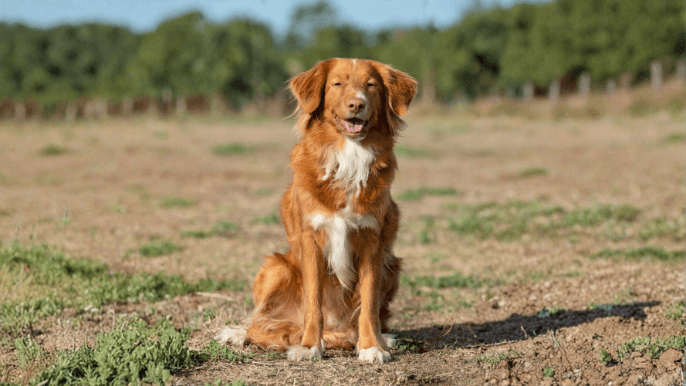
The Nova Scotia Duck Tolling Retriever wears a Feathered Long Double Coat as classified in the FurHQ seven-coat system. The coat is water-repellent with moderate feathering on the chest, legs, and tail.
The coat colour ranges from red to orange-gold, typically with white markings on the chest, feet, tail tip, and sometimes face. The water-resistant texture is medium length with a softer undercoat. The feathering is moderate compared to breeds like the Golden Retriever or Rough Collie.
The Long-Pinned Slicker Brush maintains the coat. The Undercoat Depth Comb verifies thorough grooming. The Deshedding Comb manages loose undercoat. The Long Coat Carding Rake extracts compacted undercoat. The Rubber Curry serves as a bathing tool.
The recommended kit is the FurHQ Starter Grooming Kit: Feathered Long Double Coat.
Not Sure About Your Dog's Coat Type?
Not every dog fits neatly into one coat category, and that is completely normal.
Use the FurHQ AI Coat Identifier to find out your dog's coat type and get matched to the right FurHQ Starter Grooming Kit.
Puppy Coat to Adult Coat Transition
Nova Scotia Duck Tolling Retriever puppies develop their adult coat and feathering over the first year. Regular brushing establishes the routine.
Nova Scotia Duck Tolling Retriever Temperament during this period is intensely playful and energetic. Start grooming from 8 weeks. Turn grooming into a structured game. Use Pawfect Finish Coat Spray at every session. The FurHQ 5-Step Method provides structure.
The FurHQ 5-Step Grooming Method: Technical Reality
The FurHQ 5-Step Method (Audit, Prep, Bath, Dry, Finish) applies to this coat type with emphasis on managing the dense undercoat while protecting the longer guard coat and feathering from damage.
Learn the Method. Follow the Protocol. Complete the Mission.
Setup and Stability
Secure the dog using the Stay Put System (suction cup anchor + safety lead). For anxious dogs, the Hush Pup Wrap provides calming compression. Feathered long double coats require the most thorough grooming sessions of all coat types, so patience and a calm environment are essential.
Tools and Technique
Audit: Begin every session by running your hands over the entire body, parting the coat to check for mats at the skin level. Focus on behind the ears, armpits, groin, chest ruff, hindquarter feathering, and any areas where friction occurs. The long coat hides mats effectively, so hands-on assessment is non-negotiable.
Prep: Mist with Pawfect Finish Coat Spray before any tool touches the coat. Use the Long-Pinned Slicker Brush to line brush section by section, working from the skin outward through both the undercoat and the longer guard coat. Verify every section with the Undercoat Depth Comb. If the comb catches, go back to the slicker. Use the Deshedding Comb for undercoat removal on alternating weeks. Use the Long Coat Carding Rake once every two weeks for dead undercoat, alternating weeks with the Deshedding Comb.
Bath: Use Rubber Curry during bathing for skin stimulation and to work shampoo through the dense coat. Full saturation to the skin is critical and takes time on a coat this dense. Rinse thoroughly, working water through the full length.
Dry: Towel dry without rubbing. Use a dryer with a brush-through, lifting and separating the coat as it dries. Apply Pawfect Finish Coat Spray pre-dry for protection. Significant undercoat blows out during this step. The coat should be dried thoroughly to the skin, and the feathering should be straightened during drying.
Finish: Final comb-through with the Undercoat Depth Comb to verify the coat is free of tangles, dry to the skin, and the feathering is smooth and draping naturally. Assess overall coat condition.
Blow-out season is where the real coat work lives. Stay ahead of undercoat release early, and the rest of the year stays easy.
Chemistry and Coat Care
Deep Clean Delight Shampoo provides a deep cleanse that penetrates the dense double coat to the skin. Coat-Quench Conditioner provides slip, moisture, and tangle prevention for the longer guard coat and feathering, supporting easier brushing and reducing breakage.
The Coat Release Method (Condensed)
Feathered long double coats carry dense undercoat that releases seasonally in significant volume. During the Bath step, after full saturation and shampoo application, use controlled airflow in the tub while the coat is still lathered. The lubrication allows dead undercoat to release safely without friction or skin trauma. Rinse, then apply a second shampoo with the Rubber Curry to complete the release. This keeps dead coat contained in the tub rather than spread across your home. For the full step-by-step process, see The Coat Release Method for Dogs with Undercoat in Related Reading.
FurHQ Starter Grooming Kit Breakdown
The FurHQ Starter Grooming Kit: Feathered Long Double Coat is recommended for the Nova Scotia Duck Tolling Retriever.
Standard Items (included in all FurHQ kits):
- Stay Put System (suction cup anchor + safety lead + training tips)
- Hush Pup Wrap
- Rubber Curry (for bathing)
- Ear Wipes
- Pawfect Finish Coat Spray
Coat-Specific Items:
- Deep Clean Delight Shampoo
- Coat-Quench Conditioner
- Long-Pinned Slicker Brush
- Undercoat Depth Comb
- Deshedding Comb
- Long Coat Carding Rake
Total: 11 items
Each kit includes step-by-step video tutorials and informational PDFs.
 Nova Scotia Duck Tolling Retriever Temperament: Superpowers and Kryptonite
Superpowers
🌟 Unique heritage: Nova Scotia Duck Tolling Retriever Temperament comes from the only breed developed to lure waterfowl through play. Truly one of a kind.
🌟 Intense play drive: The tolling heritage creates infectious, focused, joyful play energy that is unmatched.
🌟 Striking appearance: The fox-like red-gold coat and compact retriever body create one of the most beautiful sporting breeds.
🌟 Versatile athleticism: Nova Scotia Duck Tolling Retriever Temperament excels at dock diving, agility, obedience, and field work.
🌟 Canadian pride: Canada's own sporting breed with deep Nova Scotian heritage.
🌟 Independent intelligence: Smart, focused, and capable of working at distance from the handler.
Kryptonite
⚠️ The Toller scream: A distinctive high-pitched vocalisation during excitement that can startle unprepared owners and neighbours.
⚠️ Stranger reserve: Nova Scotia Duck Tolling Retriever Temperament is not the universally friendly retriever. Strangers receive calm assessment, not enthusiasm.
⚠️ Immune-mediated conditions: The breed carries elevated rates of immune-mediated rheumatic disease (IMRD) and Addison's disease.
⚠️ Frustration intolerance: Understimulated Tollers can develop frustration-based barking, destructiveness, and anxiety.
⚠️ Seasonal blow-out: The water-resistant double coat sheds heavily twice yearly.
⚠️ Smaller breeding population: Genetic diversity considerations are important. Research breeders thoroughly.
FurHQ's Lifestyle Lens and Pro Insights
Nova Scotia Duck Tolling Retrievers are focused, cooperative, and pleasant on the grooming table. Nova Scotia Duck Tolling Retriever Temperament during grooming is calm and accepting after exercise. The breed treats grooming as a structured activity and engages accordingly.
The Toller scream conversation is unique. Nova Scotia Duck Tolling Retriever Temperament includes a high-pitched vocalisation during excitement that is neither barking nor howling but something entirely distinct. It occurs during play, anticipation of activity, and excitement. It is not a sign of distress. It is a breed characteristic. Some owners find it charming. Others find it challenging in close-neighbour settings.
The immune-mediated health conversation is important. Nova Scotia Duck Tolling Retriever Temperament comes with elevated rates of immune-mediated rheumatic disease (IMRD), a condition causing joint inflammation and stiffness, and Addison's disease. The relatively small breeding population means genetic health screening by responsible breeders is particularly important. Research breeders who test for these conditions.
Exercise for 60 minutes with play-based activities. The Toller responds to structured play better than passive exercise. Mist with Pawfect Finish Coat Spray. Card every two weeks with the Long Coat Carding Rake. Use the Deshedding Comb on alternate weeks. Verify with the Undercoat Depth Comb.
Health and Lifespan: The FurHQ Touch Test
The Nova Scotia Duck Tolling Retriever typically lives 12 to 14 years.
Regular grooming sessions serve as health assessments. Nova Scotia Duck Tolling Retriever Temperament is cooperative during examinations.
Immune-mediated rheumatic disease (IMRD) is a significant breed-specific condition causing joint inflammation. Addison's disease (hypoadrenocorticism) occurs at elevated rates. Progressive retinal atrophy is an inherited eye condition. Hip dysplasia occurs at moderate rates. Autoimmune thyroiditis is a concern. Degenerative myelopathy may affect older dogs. The relatively small breeding population makes health testing by breeders particularly important.
Every grooming session is a conversation with your dog's body. The FurHQ 5-Step Method builds that conversation into your routine.
Related Breed Comparisons
If you are considering a Nova Scotia Duck Tolling Retriever, these breeds share some characteristics but differ in important ways:
- Golden Retriever Temperament: Similar sporting heritage and coat type. More universally friendly with less independence and reserve.
- Labrador Retriever Temperament: Fellow retriever with similar drive. More outgoing and people-focused with a short coat.
- Australian Shepherd Temperament: Similar energy level and intelligence. Herding rather than sporting heritage.
- Irish Setter Temperament: Similar red colouring and sporting heritage. More outgoing with prolonged adolescence.
Related Reading
Feathered Long Double Coat Grooming
- Dog Coat Types Explained
- Coat Release Method
- How to Line Brush Your Dog
- How to Do a Comb Check on Your Dog
Comfort and Safety
- Dog Grooming Desensitisation
Tools and Products
Related Breed Blogs
- Golden Retriever Temperament
- Labrador Retriever Temperament
- Australian Shepherd Temperament
- Irish Setter Temperament
The Bottom Line
Nova Scotia Duck Tolling Retriever Temperament delivers unique tolling heritage, intense play drive, and independent intelligence in the most distinctive sporting breed. The Toller scream surprises. The stranger reserve challenges retriever expectations. The immune conditions require breeder diligence. The seasonal coat demands work. But the return is a companion whose play drive is infectious, whose striking fox-like beauty turns every head, and whose uniquely Canadian heritage connects you to one of the most fascinating hunting traditions in the sporting world.
If you are ready, the FurHQ Starter Grooming Kit: Feathered Long Double Coat gives you every tool and product you need.
Learn the Method. Follow the Protocol. Complete the Mission.
You got this. And we've got you.
Variation Clarity Statement
The Nova Scotia Duck Tolling Retriever is a purebred breed with an established standard. Weight is 17 to 23 kilograms. Colours range from red to orange-gold with white markings. The feathered long double coat is water-resistant with moderate feathering. Individual variation in coat density and drive level exists. Always assess the coat in front of you. Use the FurHQ AI Coat Identifier to get accurate identification and the right kit recommendation.
FAQs
What coat type does the Nova Scotia Duck Tolling Retriever have?
The Nova Scotia Duck Tolling Retriever has a Feathered Long Double Coat in the FurHQ seven-coat system. The seven coat types are Smooth Single Coat, Short Double Coat, Medium Plush Double Coat, Feathered Long Double Coat, Wire Coat, Curly Wavy Coat, and Drop Coat.
How often should I brush my Toller?
Brush every other day with the Long-Pinned Slicker Brush. Card with the Long Coat Carding Rake every two weeks. Use the Deshedding Comb on alternate weeks. Verify with the Coat-Specific Metal Comb. Apply Pawfect Finish Coat Sprayat every session.
What is the Toller scream?
A distinctive high-pitched vocalisation unique to the breed. Nova Scotia Duck Tolling Retriever Temperament includes this excitement response during play and anticipation. It is a breed characteristic, not distress.
Is the Toller friendly with strangers?
Reserved. Nova Scotia Duck Tolling Retriever Temperament is not the universally friendly retriever. The breed approaches strangers with calm assessment rather than enthusiasm.
What is IMRD?
Immune-mediated rheumatic disease is a breed-specific condition causing joint inflammation. Nova Scotia Duck Tolling Retriever Temperament health screening should include IMRD awareness and breeder testing.
How often should I bathe my Toller?
Bathe every 6 to 8 weeks using Deep Clean Delight Shampoo followed by Coat-Quench Conditioner. The water-resistant coat requires thorough lathering. Never bathe a matted coat.
How much exercise does a Toller need?
Nova Scotia Duck Tolling Retriever Temperament requires 60 to 90 minutes of daily combined physical and mental exercise. Play-based activities suit the tolling heritage.
Is the Toller good for first-time owners?
Possible with research and commitment. Nova Scotia Duck Tolling Retriever Temperament is more independent than typical retrievers. The breed suits owners prepared for the reserve and drive.
What tools and products are in the FurHQ Starter Grooming Kit: Feathered Long Double Coat?
The FurHQ Starter Grooming Kit: Feathered Long Double Coat contains 11 items. Coat-specific: Deep Clean Delight Shampoo, Coat-Quench Conditioner, Long-Pinned Slicker Brush, Coat-Specific Metal Comb, Deshedding Comb, Long Coat Carding Rake. Standard: Stay Put System, Hush Pup Wrap, Rubber Curry, Ear Wipes, Pawfect Finish Coat Spray.
Is the Toller a good family dog?
Yes, for active families. Nova Scotia Duck Tolling Retriever Temperament bonds deeply with family and enjoys children who participate in active play.
How does the FurHQ 5-Step Method work for the Toller?
The FurHQ 5-Step Method (Audit, Prep, Bath, Dry, Finish) requires exercise first. Audit checks feathering, undercoat, and health. Prep mists with Pawfect Finish Coat Spray, brushes section by section, cards every two weeks, deshedding alternate weeks. The Coat Release Method supports coat turnover. Bath uses Deep Clean Delight Shampoo (thorough lathering on water-resistant coat) and Coat-Quench Conditioner. Dry thoroughly. Finish applies Pawfect Finish Coat Spray.
What FurHQ Starter Grooming Kits are available?
FurHQ offers seven coat-specific kits: FurHQ Starter Grooming Kit: Smooth Single Coat, FurHQ Starter Grooming Kit: Short Double Coat, FurHQ Starter Grooming Kit: Medium Plush Double Coat, FurHQ Starter Grooming Kit: Feathered Long Double Coat, FurHQ Starter Grooming Kit: Wire Coat, FurHQ Starter Grooming Kit: Curly Wavy Coat, and FurHQ Starter Grooming Kit: Drop Coat. Use the FurHQ AI Coat Identifier for accurate classification or visit the FurHQ Store.