
Coat Release Method Without an HV Dryer
Table of Contents
- Introduction
- How the Modified Method Differs from the Full Version
- Step 1: Audit (Assess the Coat Before You Begin)
- Step 2: Prep (Remove Loose Coat and Address Tangles)
- Step 3: Bath (The Core of the Coat Release Method Without an HV Dryer)
- Step 4: Dry (Towel Dry and Air Dry)
- Step 5: Finish (Final Brush-Through and Assessment)
- What You Gain and What You Miss Without the HV Dryer
- Which Coat Types Use the Coat Release Method Without an HV Dryer
- How Often to Use the Coat Release Method Without an HV Dryer
- Common Mistakes to Avoid
- When to Upgrade to the Full Coat Release Method
- The FurHQ 5-Step at a Glance for the Coat Release Method Without an HV Dryer
- Related Reading
- The Bottom Line
- Variation Clarity Statement
- FAQs
 Introduction
The Coat Release Method without an HV dryer is the modified version of FurHQ's bathing technique for pet parents who do not yet have a high velocity dryer. If you have a dog that carries undercoat and you are tired of constant shedding despite regular brushing, this method will help. The full Coat Release Method uses controlled airflow from an HV dryer as its primary release tool, but not everyone starts with that equipment. This version replaces the airflow phase with brush-through techniques on a shampooed coat, giving you a highly effective deshedding bath using tools you already have.
The Coat Release Method without an HV dryer still follows the same core principle: dead coat releases most efficiently when the coat is lubricated. Shampoo creates slip that allows a brush to move through the coat without friction, reaching dead undercoat that dry brushing alone cannot access. Instead of airflow doing the release work, your rubber curry or slicker brush does it while the coat is wet and lubricated. The result is significantly more dead coat removal than a standard bath, even without a dryer.
This method works for Short Double Coats, Medium Plush Double Coats, Feathered Long Double Coats, and Wire Coats. If your dog sheds undercoat and you do not have an HV dryer, this is your starting point. The Coat Release Method without an HV dryer follows the FurHQ 5-Step Grooming Method, Audit, Prep, Bath, Dry, Finish, adapted for pet parents working without professional drying equipment.
How the Modified Method Differs from the Full Version
The full Coat Release Method uses HV airflow on a shampooed coat to physically move through the coat layers and release dead undercoat from the follicle. It is the most efficient version because airflow penetrates deeper into the coat than any brush can reach, and it does so without mechanical contact.
The Coat Release Method without an HV dryer replaces that airflow phase with brush-through work on the shampooed coat. A rubber curry or slicker brush, combined with shampoo lubrication, provides the mechanical action needed to loosen and release dead coat. The shampoo slip protects the skin and coat from friction damage, which is why this works where dry brushing falls short.
The other key difference is drying. Without an HV dryer, you towel dry thoroughly and allow the coat to air dry. This takes longer and does not provide the additional coat release that HV drying produces, but it is a completely valid approach that still delivers meaningful results.
If you find yourself doing the Coat Release Method without an HV dryer regularly and wanting better results, the HV dryer is the upgrade that takes the technique to its full potential. But this version gets you started with what you have.
No HV dryer? No problem - you can still support coat release during the bathing process. It won’t equal the power of forced air, but done correctly, it will dramatically improve shedding results and coat health.
Step 1: Audit (Assess the Coat Before You Begin)
Every grooming session starts with the Audit. Before your dog goes anywhere near water, take a few minutes to evaluate what you are working with.
Run your hands through the coat from head to tail, feeling for areas of dense, packed undercoat. Check behind the ears, the chest, the underside, the rear end, and anywhere coat grows thickest. You are looking for how much dead coat is sitting in the coat and whether there are any mats or tangles that need attention before the bath.
If you find tangles, particularly in feathered areas on Feathered Long Double Coats or in the furnishings on Wire Coats, note where they are. Small tangles can often be worked through during the Prep phase. Mats that are tight to the skin may need professional attention before proceeding.
The Audit also helps you plan your session. A dog with heavy dead coat will need more thorough brush-through work during the Bath phase. A dog with a lighter coat load may move through the process more quickly.
What to look for during the Audit:
- Packed undercoat that feels dense and tight near the skin
- Tangles or early mat formation, especially behind the ears, in the armpits, and around the collar area
- Skin condition, including any redness, irritation, or sensitivity
- Areas where dead coat is already pulling free easily, indicating heavy coat release is imminent
- Overall coat condition to determine whether you need one or two brush-through cycles
Step 2: Prep (Remove Loose Coat and Address Tangles)
The Prep phase gets the coat ready for the bath. Working through the coat before it gets wet prevents tangles from tightening and ensures shampoo can reach the skin during the release process.
Use your rubber curry to work through the coat in sections, loosening surface debris and dead coat that is ready to release. For Short Double Coats and Medium Plush Double Coats, the rubber curry is typically all you need. For Feathered Long Double Coats and Wire Coats, use your slicker brush on feathered areas and furnishings where tangles are most likely to form.
Work methodically from rear to front, covering the entire coat. Pay extra attention to the areas you identified during the Audit. If you encounter tangles, work them out gently with your slicker using short, controlled strokes. Do not force through knots, as this causes discomfort and skin trauma.
The Prep phase is not about achieving a perfectly smooth coat. It is about removing enough loose coat and addressing enough tangles that the Bath phase can do its job effectively. A few minutes of thorough prep work makes every step that follows more productive.
Prep essentials:
- Rubber curry for general coat work on body coat
- Slicker brush for feathered areas, furnishings, and tangles
- Work in sections from rear to front
- Remove loose coat and debris
- Address tangles before they tighten in water
Step 3: Bath (The Core of the Coat Release Method Without an HV Dryer)
The Bath phase is where the real release work happens. This is the heart of the Coat Release Method without an HV dryer, and it follows a specific sequence designed to maximise dead coat removal using shampoo lubrication and mechanical brush-through.
Gather everything within reach before you begin. You do not want to leave a wet, soapy dog to search for supplies.
Equipment checklist:
- Rubber Curry: Your primary tool for distributing shampoo and providing mechanical release during the brush-through phases. This is the safer tool option and should be your default
- Slicker Brush: Used when dense coat remains and the rubber curry needs additional support. Requires feather-light pressure and careful technique. Choose the pin length matched to your dog's coat type
- Coat-matched Shampoo: Use the shampoo designed for your dog's coat type. The shampoo needs to reach the skin, not just foam on the surface
- Coat-matched Conditioner: All coats with undercoat are conditioned after the release process, with levels adjusted by coat type
- Drain Filter: Dead coat will fill your drain quickly. Always have a filter in place and clean it during the bath as needed. Drain filters are inexpensive and available at most hardware stores. A simple mesh or silicone filter is all you need
- Towels: Multiple absorbent towels for thorough towel drying. You will need more towels than you think, especially for larger dogs or dogs with dense coats
Full Saturation: Foundation of Release
Thoroughly wet the coat to the skin, pushing water through all coat layers. Do not proceed until the skin is fully wet.
This is not a quick rinse. On a thick coat with undercoat, full saturation can take several minutes. Work the water into the coat with your hands, lifting and separating the coat as you go. Pay particular attention to the chest, behind the ears, the underside, and the rear end where coat is typically densest.
Dry pockets block shampoo penetration and prevent proper release. If shampoo cannot reach the skin, this method cannot work effectively. Every step that follows depends on complete saturation first.
First Shampoo and Brush-Through: Emulsification and Initial Release
Apply coat-matched shampoo and distribute it through the coat using your rubber curry. Focus on skin contact, not surface foam.
Work in sections, starting from the rear and moving forward. The rubber curry pushes shampoo down to the skin and begins loosening debris and dead coat through gentle circular motions. You should feel the curry contacting the skin through the coat, not just gliding over the top layer.
Once the shampoo is distributed, work through the coat methodically with the rubber curry. The shampoo lubrication allows the curry to move through the coat without friction, loosening dead undercoat as you go. You will feel dead coat releasing and see it accumulating in the tub.
For areas with particularly dense coat where the curry is not providing enough release, you can switch to your slicker brush. Use feather-light pressure only. Short, controlled strokes. Never stay in one area for extended passes. If the skin begins to pink, stop immediately and return to the rubber curry. The shampoo slip is protecting the skin, but the slicker still requires careful technique.
The shampoo breaks down oil, debris, and compacted coat, creating the lubrication that allows your brush to release dead coat without friction or skin trauma. This brush-through phase replaces the airflow phase in the full Coat Release Method.
Full Rinse: Clear What Was Released
Rinse thoroughly to remove shampoo, released coat, and debris.
Take your time here. Run your fingers through the coat while rinsing to help flush loosened coat out. Check the drain filter and clean it if it is getting full. The volume of dead coat released during the first brush-through phase is often surprising.
What has been released must be removed before continuing. Leaving loosened coat and shampoo residue in the coat blocks the effectiveness of the second shampoo application.
Second Shampoo and Brush-Through: Completing Release
Re-wet the coat if needed and apply shampoo again. This application finishes what the first brush-through started.
Repeat the brush-through process using your rubber curry as the default tool. The second pass through a cleaner coat often releases additional dead undercoat that was too compacted to release during the first round. Work methodically through every section of the coat.
If dense coat remains after the curry work, use your slicker brush with the same careful technique as before. Feather-light pressure, short controlled strokes, and constant monitoring for skin pinking. This modified method relies on these two brush-through phases to do the work that airflow handles in the full version, so thorough coverage matters.
This step completes the release while the coat remains lubricated. Two full shampoo and brush-through cycles access dead coat that a single pass cannot reach, particularly in breeds with very dense undercoat.
Full Rinse: End of the Release Phase
Rinse completely until the coat is clean and residue-free. Run your fingers through the coat to confirm all shampoo and loosened coat has been removed.
This rinse must be thorough. Any remaining shampoo interferes with skin comfort and coat structure. The coat should feel clean between your fingers with no slippery residue remaining. Residual shampoo causes skin irritation and affects how conditioner performs in the next step.
Conditioning
Apply conditioner where the coat benefits, using only what the coat type requires. The rubber curry can be used to distribute conditioner through the coat, just as it was used during the shampoo phases.
Conditioning by coat type:
- Short Double Coats: Light conditioning, primarily for skin comfort and coat balance
- Medium Plush Double Coats: Moderate conditioning to support manageability without creating excess softness
- Feathered Long Double Coats: Conditioning focused on feathered areas where tangles are most likely, while keeping the body coat balanced
- Wire Coats: Condition lightly and selectively, typically limited to furnishings and friction-prone areas, while preserving structure and texture on the body coat
Over-conditioning can interfere with coat structure, particularly on wire coats and dense double coats.
Final Rinse
Rinse thoroughly so the coat feels clean and balanced, not slick. If the coat still feels slippery after rinsing, rinse again. Product left in the coat weighs it down and attracts dirt.
Step 4: Dry (Towel Dry and Air Dry)
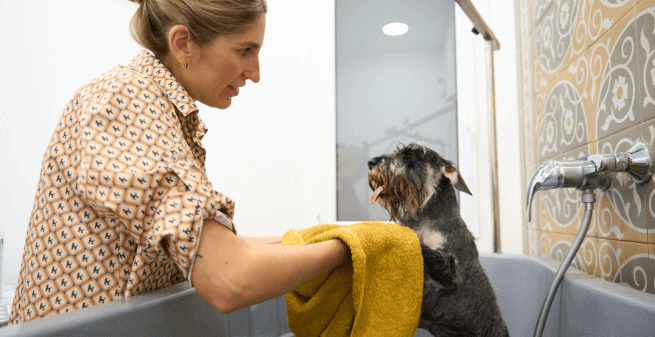
Without an HV dryer, the Dry phase relies on thorough towel drying followed by air drying. This takes longer than HV drying but is a completely valid approach when done properly.
Towel dry thoroughly, pressing the towel into the coat to absorb as much water as possible. Do not rub aggressively, as this creates friction and tangles, especially on longer coats. Use multiple towels if needed, particularly on larger dogs or breeds with very dense coat.
After towel drying, allow the coat to air dry in a warm, well-ventilated area. Air drying takes significantly longer than HV drying, especially on dense coats. Keep your dog comfortable and out of drafts during the drying process.
Thorough towel drying reduces air dry time and prevents your dog from getting chilled. This method requires patience during the drying phase, but proper towel technique makes a significant difference in how quickly the coat dries.
Step 5: Finish (Final Brush-Through and Assessment)
The Finish phase completes the process and catches any remaining dead coat that was loosened during the bath but not fully removed.
For Medium Plush Double Coats and Feathered Long Double Coats, brush through gently with your slicker once the coat reaches approximately 80 to 90 percent dry. This helps prevent the coat from drying in clumps and catches any remaining loose undercoat. Work with the direction of coat growth and use light pressure.
For Short Double Coats, a final pass with the rubber curry once the coat is nearly dry helps lift any remaining loose undercoat close to the skin.
For Wire Coats, a light slicker pass on furnishings and a rubber curry pass on the body coat finishes the session while preserving wire texture.
Once the coat is fully dry, run your hands through it again, just as you did during the Audit. You should feel a noticeable difference in density. The coat should feel lighter, cleaner, and more open than before the session. This final check confirms the method did its job.
Finish phase by coat type:
- Short Double Coats: Rubber curry pass at 80 to 90 percent dry
- Medium Plush Double Coats: Gentle slicker brush-through at 80 to 90 percent dry, working with coat growth direction
- Feathered Long Double Coats: Slicker brush-through on feathered areas and body coat at 80 to 90 percent dry, with extra attention to areas where tangles form during drying
- Wire Coats: Light slicker on furnishings, rubber curry on body coat, preserving texture throughout
What You Gain and What You Miss Without the HV Dryer
The Coat Release Method without an HV dryer is genuinely effective. The two brush-through phases on a shampooed coat release substantially more dead undercoat than dry brushing or a standard bath. The shampoo lubrication is doing the heavy lifting, and the mechanical action of the curry and slicker provides release that you simply cannot achieve on a dry coat.
What you miss is the depth of penetration that concentrated airflow provides. An HV dryer moves air through all layers of the coat simultaneously, reaching dead undercoat that even a brush on a shampooed coat cannot access. It also makes the drying phase faster and provides additional coat release during drying itself.
This modified method removes a significant percentage of dead undercoat. The full version with the HV dryer removes more. Both are far better than dry brushing alone.
If you start with this modified version and find yourself wanting better results, the HV dryer is the single most impactful upgrade you can make to your home grooming setup.
Which Coat Types Use the Coat Release Method Without an HV Dryer
The Coat Release Method without an HV dryer works for the same coat types as the full version, with the same principle: if the coat carries undercoat, this technique applies.
Short Double Coat breeds benefit from the brush-through phases because the tight coat structure traps dead undercoat close to the skin. The rubber curry is particularly effective on short coats because it can reach the skin easily through the shorter topcoat .
Medium Plush Double Coat breeds respond well to the modified method because the medium coat length gives the curry and slicker enough coat to work through while still reaching the undercoat. The gentle brush-through during the Finish phase is especially helpful for these coats.
Feathered Long Double Coat breeds require extra attention during the brush-through phases because the longer coat and feathering create more areas where dead coat can hide. Take additional time with the slicker on feathered areas during the second brush-through.
Wire Coat breeds benefit from the curry work on the body while the slicker can be used selectively on furnishings. Preserve the wire texture by keeping slicker work light on the body coat.
The Coat Release Method without an HV dryer is not used on Smooth Single Coats, Curly Wavy Coats, or Drop Coats. These coat types do not carry the undercoat structure that this technique is designed to address, or they require different bathing approaches suited to their specific coat behaviour.
Not sure which coat type your dog has? Upload a photo to the FurHQ AI Coat Identifier and it will tell you your dog's coat type and the kit that matches.
How Often to Use the Coat Release Method Without an HV Dryer
Frequency follows the same guidelines as the full Coat Release Method.
During seasonal coat changes in spring and autumn, most dogs with undercoat benefit from a session every two to four weeks. Outside of seasonal transitions, monthly sessions are typically sufficient for most breeds. Some dogs with particularly dense coats may need sessions more frequently.
Because the Coat Release Method without an HV dryer does not release quite as much dead coat per session as the full method, you may find that slightly more frequent sessions help keep shedding under control during heavy coat change periods.
Watch your dog's coat for these signals:
- Loose undercoat pulling free easily when you run your hands through the coat
- Increased household shedding on furniture, clothing, and floors
- A coat that feels dense and packed near the skin
- Dead coat visible when you part the coat and look at the undercoat layer
- The coat feels heavier or thicker than usual despite regular brushing
Common Mistakes to Avoid
Skipping full saturation. Rushing the initial wetting is the most common mistake with this method. If the coat is not wet to the skin, shampoo cannot penetrate and the brush-through phases will be fighting dry pockets instead of releasing dead coat.
Pressing too hard with the slicker. The shampoo lubrication does most of the work. The brush assists. If you are pressing into the coat, you are pressing too hard. Feather-light pressure allows the slip to do its job. If the skin pinks, stop and switch to the curry.
Skipping the second shampoo. Without airflow to do the deep release work, the two brush-through phases are essential. The first loosens and begins release. The second finishes it. Skipping the second application leaves dead coat in the coat that was starting to release.
Rubbing aggressively with towels. Press and squeeze the towel into the coat rather than rubbing back and forth. Rubbing creates friction and tangles, especially on medium and longer coats. Multiple towels pressed into the coat remove more water than one towel rubbed across the surface.
Forgetting the drain filter. Even without an HV dryer, this method releases significant amounts of dead coat into the tub. The drain filter is not optional.
Skipping the Audit. Starting the bath without assessing the coat means you do not know what you are working with. The Audit tells you where the heaviest dead coat is sitting, whether tangles need attention before the coat gets wet, and how much work the Bath phase will require.
Skipping the Finish phase brush-through. For Medium Plush and Feathered Long Double Coats, a gentle slicker brush-through at 80 to 90 percent dry catches remaining loose coat and prevents the coat from drying in clumps. Skipping this step means leaving release potential on the table and potentially creating tangles in the drying coat.
When to Upgrade to the Full Coat Release Method
The Coat Release Method without an HV dryer is a strong starting point, but there are signs that upgrading to the full version would benefit your dog's coat management.
If you are doing sessions every two weeks and still seeing heavy household shedding between sessions, the HV dryer will access deeper dead coat that the brush-through cannot reach. If bath sessions are taking over an hour because of the extended brush-through and air drying time, the HV dryer dramatically reduces both phases. If your dog has a particularly dense coat and you feel like you are leaving dead undercoat behind despite thorough work, the airflow penetration of the HV dryer is the solution.
The HV dryer does not replace the technique. It enhances it. Everything you learn doing the Coat Release Method without an HV dryer transfers directly to the full version. You already understand saturation, shampoo lubrication, and controlled brush-through. Adding airflow takes what you already know and makes it more effective.
The FurHQ 5-Step at a Glance for the Coat Release Method Without an HV Dryer
The Coat Release Method without an HV dryer maps directly onto the FurHQ 5-Step Grooming Method. Here is the complete flow at a glance.
Audit: Run your hands through the coat. Feel for packed undercoat, tangles, and coat density. Identify problem areas and plan your session.
Prep: Remove loose surface coat with the rubber curry. Address tangles with the slicker brush. Get the coat ready so shampoo can reach the skin.
Bath: Full saturation, first shampoo with curry brush-through, full rinse, second shampoo with curry brush-through (slicker if needed), full rinse, condition by coat type, final rinse.
Dry: Thorough towel drying with press-and-squeeze technique. Air dry in a warm, well-ventilated area.
Finish: Gentle brush-through at 80 to 90 percent dry. Final hands-on assessment to confirm dead coat removal. The coat should feel lighter, cleaner, and more open.
Related Reading
- How to Introduce Your Dog to a Dryer
- How to Line Brush Your Dog
- Touch Test for Dogs
- How Often Should You Bathe Your Dog Based on Coat Type
- High Velocity Dryer for Dogs
The Bottom Line
The Coat Release Method without an HV dryer proves that good technique matters more than expensive equipment. Yes, the full version with an HV dryer is more effective. But this modified method still delivers dramatically better results than dry brushing or a standard bath. The core principle is the same: shampoo lubrication plus mechanical action releases dead coat that dry brushing alone simply cannot reach.
The FurHQ 5-Step Grooming Method gives this process structure. Audit the coat so you know what you are working with. Prep by removing loose coat and addressing tangles. Bath with two full shampoo and brush-through cycles on a lubricated coat. Dry thoroughly with towels and air drying. Finish with a gentle brush-through to catch remaining dead coat and confirm results.
Every FurHQ Starter Grooming Kit: Short Double Coat, FurHQ Starter Grooming Kit: Medium Plush Double Coat, FurHQ Starter Grooming Kit: Feathered Long Double Coat, and FurHQ Starter Grooming Kit: Wire Coat includes the rubber curry, coat-matched shampoo, conditioner, and brushing tools you need for your dog's specific coat type, plus access to step by step video tutorials that walk you through the entire process. You do not have to figure this out alone.
You got this. And we have got you. 🐾
Variation Clarity Statement
Every dog is an individual. Coat density, shedding patterns, skin sensitivity, and tolerance levels vary even within the same breed. The information in this blog represents general guidance based on coat type classifications. Your dog's specific needs may require adjustments to frequency, tool selection, or technique. When in doubt, consult a Certified Professional Groomer familiar with your dog's coat type. If you are unsure about your dog's coat type, use the FurHQ AI Coat Identifier to get accurate identification and the right kit recommendation.
FAQs
What is the Coat Release Method without an HV dryer?
The Coat Release Method without an HV dryer is a modified bathing technique that uses shampoo lubrication and brush-through work to release dead undercoat during the bath. Instead of using high velocity airflow on a shampooed coat (which is how the full version works), this method uses a rubber curry or slicker brush to provide the mechanical action that loosens and releases dead coat. The shampoo creates slip that protects the skin from friction while allowing the brush to reach deep into the coat layers.
Which coat types can use the Coat Release Method without an HV dryer?
The Coat Release Method without an HV dryer works on any coat type that carries undercoat. This includes Short Double Coats, Medium Plush Double Coats, Feathered Long Double Coats, and Wire Coats. It does not apply to Smooth Single Coats, Curly Wavy Coats, or Drop Coats, as these coat types do not carry the undercoat structure that this technique is designed to address.
Why do I need two shampoo applications?
Without airflow to penetrate deep into the coat layers, this method depends on two brush-through cycles to achieve thorough dead coat removal. The first shampoo and brush-through loosens and begins releasing dead undercoat. The second shampoo and brush-through works through a cleaner coat and accesses dead undercoat that was too compacted to release during the first round. Skipping the second application leaves dead coat behind.
Can I use any shampoo for the Coat Release Method without an HV dryer?
Use the shampoo matched to your dog's coat type for best results. Short Double Coats, Medium Plush Double Coats, and Feathered Long Double Coats use Deep Clean Delight Shampoo. Wire Coats use Texture-Tastic Shampoo. The right shampoo creates the proper slip needed for effective brush-through while supporting your dog's specific coat structure.
How often should I do the Coat Release Method without an HV dryer?
During seasonal coat changes in spring and autumn, every two to four weeks is typical. Outside of seasonal transitions, monthly sessions work for most breeds. Because this modified method does not release quite as much dead coat per session as the full version, slightly more frequent sessions may help during heavy coat change periods. Watch for signs of heavy coat load like increased household shedding, packed undercoat near the skin, and loose undercoat pulling free easily.
What is the difference between the rubber curry and the slicker brush during the bath?
The rubber curry is your default tool for this method. It distributes shampoo to the skin, provides gentle mechanical release through circular motions, and carries virtually no risk of skin irritation. The slicker brush provides more aggressive mechanical release and is used when dense coat remains after the curry work. The slicker requires feather-light pressure, short controlled strokes, and constant monitoring for skin pinking. If the skin begins to show any redness, stop the slicker immediately and return to the curry.
Do I need to condition after the Coat Release Method without an HV dryer?
Yes. All coats with undercoat benefit from conditioning after this method, with levels adjusted by coat type. Short Double Coats receive light conditioning for skin comfort. Medium Plush Double Coats receive moderate conditioning for manageability. Feathered Long Double Coats receive conditioning focused on feathered areas. Wire Coats receive selective conditioning on furnishings and friction-prone areas only, preserving texture on the body coat.
Why is the Audit important before starting?
The Audit is the first step of the FurHQ 5-Step Grooming Method and it tells you exactly what you are working with before any water touches the coat. Feeling the coat lets you identify where the heaviest dead coat is sitting, whether tangles need attention before the bath, and how much brush-through work the Bath phase will require. Skipping the Audit means going in blind, which often leads to missed areas and incomplete results.
How do I know if the Coat Release Method without an HV dryer is working?
You will see dead coat accumulating in the tub during the brush-through phases and filling the drain filter. After the session, the coat should feel noticeably lighter, cleaner, and more open when you run your hands through it during the Finish phase. Household shedding should decrease in the days following the session. If you are not seeing meaningful dead coat release, the most common causes are incomplete saturation, not enough brush-through time, or skipping the second shampoo application.
When should I upgrade to the full Coat Release Method with an HV dryer?
Consider upgrading if you are doing sessions every two weeks and still seeing heavy household shedding, if sessions are taking over an hour due to extended brush-through and air drying time, or if you feel like you are leaving dead undercoat behind despite thorough work. The HV dryer accesses deeper dead coat that brush-through alone cannot reach and dramatically reduces both the release and drying phases. Everything you learn from the Coat Release Method without an HV dryer transfers directly to the full version.
What is the FurHQ 5-Step Grooming Method?
The FurHQ 5-Step Grooming Method is Audit, Prep, Bath, Dry, Finish. It provides structure for every grooming session so nothing gets missed. The Audit assesses the coat before you start. The Prep phase removes loose coat and addresses tangles. The Bath phase handles cleansing and, for the Coat Release Method without an HV dryer, the two shampoo and brush-through cycles. The Dry phase removes moisture. The Finish phase completes the groom with a final brush-through and assessment.