
Dog Body Language During Grooming: When to Stop
Table of Contents
- Introduction
- The Ladder of Communication: Understanding Dog Body Language During Grooming
- The Green Zone: Calm and Comfortable
- The Yellow Zone: Early Warning Signals
- The Orange Zone: Moderate to High Stress
- The Red Zone: At or Near Limit
- Context Matters: Reading the Whole Dog
- When to Stop: Clear Guidelines
- Building Trust Through Listening
- When Professional Help Is Needed
- Practical Application: Common Scenarios
- The Touch Test: Checking In With Your Dog
- FurHQ Tools That Support Low-Stress Grooming
- Desensitisation: Teaching Your Dog to Accept Grooming
- Related Reading
- The Bottom Line
- FAQs
 Introduction
Dog body language during grooming tells you everything you need to know about how your dog is feeling, if you know how to read it. Every lip lick, yawn, and turned head is your dog communicating with you. They are saying "I am uncomfortable" or "please stop" or "I need a break" long before they escalate to growling or snapping. The problem is that most pet parents do not speak this language fluently.
Here is what happens when we miss these signals: we push through. We finish the nail trim even though our dog is trembling. We keep brushing even though they are trying to move away. We tell ourselves "just one more minute" while our dog's stress builds higher and higher. And then one day, our dog growls. Or snaps. Or bites. And we say it came out of nowhere.
It did not come out of nowhere. Our dog was talking the whole time. We just were not listening.
Understanding dog body language during grooming transforms the experience for everyone. You learn to spot stress early, take breaks before your dog reaches their limit, and build trust instead of eroding it. This guide will teach you to read your dog's signals, recognise the ladder of communication, know exactly when to stop, and understand when professional help is needed.
The Ladder of Communication: Understanding Dog Body Language During Grooming
Veterinary behaviourist Dr. Kendal Shepherd developed a concept called the Ladder of Aggression (also known as the Ladder of Communication) that explains how dogs express increasing levels of stress. Understanding this ladder is essential for reading dog body language during grooming effectively.
How the Ladder Works
Think of it as a series of steps, with mild signals at the bottom and severe reactions at the top.
| Level | Signals | What Dog Is Saying |
|---|---|---|
| Bottom (Subtle) | Blinking, lip licking, yawning, head turning | "I am a little worried. Can we slow down please?" |
| Middle (Obvious) | Moving away, crouching, tail tucking, whale eye | "I really need this to stop." |
| Upper (Clear Warning) | Freezing, hard stare, growling | "Stop now or I will have to make you stop." |
| Top (Last Resort) | Snapping, biting | All other communication has failed |
Important: Dogs do not want to bite. Biting is costly and dangerous. Dogs use the signals on the lower rungs of the ladder to avoid conflict and ask for space. They only climb higher when the lower signals are ignored.
Why This Matters for Grooming
| When You Listen to Subtle Signals | When You Ignore Subtle Signals |
|---|---|
| Dog learns communication works | Dog learns subtle signals do not work |
| Dog stays calmer in future sessions | Dog skips to growling or biting faster |
| Trust builds over time | Trust erodes over time |
| Grooming becomes easier | Grooming becomes harder |
| You become a partner who listens | You become a threat who ignores |
Important: Never punish a growl. A growl is valuable communication. If you punish growling, you teach your dog that growling does not work, and they may skip straight to biting next time.
The Green Zone: Calm and Comfortable
The green zone represents a calm, comfortable dog. Learning to recognise dog body language during grooming starts with knowing what relaxed looks like.
Green Zone Signals
| Signal | What It Looks Like |
|---|---|
| Relaxed body | Loose muscles; fluid movement without stiffness or tension; natural weight shifting |
| Soft eyes | Almond-shaped with no visible tension; smooth forehead; slow, natural blinking |
| Neutral ears | Natural resting position for breed; relaxed at base |
| Loose mouth | Slightly open in relaxed pant or closed without tension; corners not pulled tight |
| Natural tail | Natural resting position for breed; may wag loosely and slowly; no stiffness or tucking |
| Willing participation | Accepts handling without resistance; may lean into touch; takes treats readily |
What this means for grooming: When you see green zone signals, you can continue grooming at your current pace. Your dog is comfortable with what is happening.
The Yellow Zone: Early Warning Signals
The yellow zone represents early stress signals. These are the subtle communications that most people miss. Learning to recognise yellow zone signals is the most important skill in reading dog body language during grooming.
Yellow Zone Signals
| Signal | What It Looks Like | What It Means |
|---|---|---|
| Lip licking or tongue flicking | Quick flick of tongue over lips or nose when no food is present | One of the most common calming signals; may be very fast and easy to miss |
| Yawning | Yawn when dog is not tired | Releases jaw tension; self-soothing; indicates discomfort |
| Blinking or squinting | Rapid blinking or prolonged eye closing | Trying to appear non-threatening; asking for same in return |
| Head turning or looking away | Deliberately turns head away or averts gaze | Asking for interaction to end; often misread as "stubborn" |
| Sniffing the ground | Sudden intense interest in sniffing nothing new | Displacement behaviour; redirecting own stress |
| Slow movements | Suddenly moves very slowly and deliberately | Appeasement behaviour; trying to appear non-threatening |
| Paw lift | Lifting one front paw while standing | Uncertainty or mild anxiety |
| Shake off | Full body shake (like after water) when not wet | Stress release behaviour; often after mildly stressful moment passes |
What This Means for Grooming
Yellow zone signals are your early warning system. When you see them:
| Action | Why |
|---|---|
| Pause | Give your dog a moment to regroup |
| Offer a treat | Positive association; gauge willingness to continue |
| Assess your approach | Is something causing discomfort? |
| Give praise | Verbal reassurance |
| Check readiness | Watch if dog is ready to continue or needs more time |
The goal: Keep your dog in the green zone by responding to yellow signals before they escalate.
The Orange Zone: Moderate to High Stress
Orange zone signals indicate moderate to high stress. When reading dog body language during grooming, these signals tell you that your dog is no longer just uncomfortable. They are actively worried and asking for the situation to stop.
Orange Zone Signals
| Signal | What It Looks Like | Severity |
|---|---|---|
| Whale eye | Head turned away but eyes fixed on stressor; whites of eyes visible (crescent shape) | Significant stress |
| Ears pinned back | Ears flattened against head or pulled back tightly | Fear or high stress (all ear types) |
| Closed tight mouth | Suddenly closes mouth tightly (especially after panting); lips may be pulled back | Escalating concern |
| Rapid panting | Fast, shallow panting when not hot | Stress indicator |
| Trying to move away | Pulling back, stepping away, turning body, moving toward exit | Creating distance from stressor |
| Crouching or cowering | Lowering body, tucking tail, hunching shoulders | Making self smaller; avoiding conflict |
| Tucked tail | Tail pressed against belly or tucked between legs | Clear fear indicator |
| Drooling | Excessive drooling when no food present | Extreme stress or anxiety-induced nausea |
| Refusing treats | Dog who normally takes treats readily suddenly refuses | Too stressed to eat; significant warning |
What This Means for Grooming
Orange zone signals mean stop. Your dog needs a break now, not in a minute.
| Do | Do Not |
|---|---|
| End the current activity immediately | Try to finish "just one more thing" |
| Give your dog space | Hold your dog tighter |
| Let them decompress | Continue at a faster pace |
| Assess what triggered the escalation | Push toward the red zone |
Important: If you continue grooming when your dog is in the orange zone, you are teaching them that their communication does not matter. You are also pushing them toward the red zone.
The Red Zone: At or Near Limit
Red zone signals indicate a dog who is at or near their limit. These are the unmistakable warning signs that most people do recognise, but by this point, the dog has already been communicating for a while without being heard.
Red Zone Signals
| Signal | What It Looks Like | What It Means |
|---|---|---|
| Freezing | Completely still, rigid; stopped all movement | Moment before action; dog is deciding what to do next; EXTREMELY SERIOUS |
| Hard stare | Intense, unblinking eye contact; fixed, hard expression; round eyes with dilated pupils | Clear warning |
| Raised hackles | Hair along spine and shoulders stands up (piloerection) | High arousal; making self appear larger |
| Stiff body | Complete body tension; every muscle tight; may lean forward or hold very still | No looseness anywhere |
| Growling | Low, rumbling vocalisation | Final warning; "back off"; NEVER PUNISH |
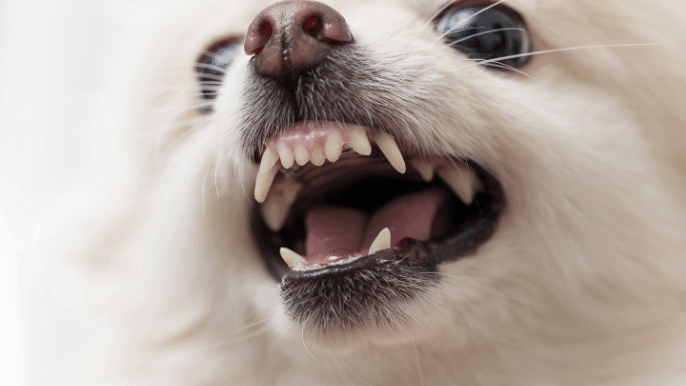
| Showing teeth | Lips pulled back to expose teeth; often with wrinkled muzzle | Threat display |
| Snapping | Quick bite at air near you without making contact | Warning bite; dog CHOSE not to make contact |
| Biting | Physical contact with teeth | Top of ladder; all other options exhausted |
What This Means for Grooming
Red zone signals mean the session is over. Stop immediately.
| Do | Do Not |
|---|---|
| Stop immediately | Try to finish one more nail |
| Create space | Push through |
| Let your dog decompress completely | Scold or punish |
| Plan a different approach for next time | Continue as if nothing happened |
Important: A dog who reaches the red zone during grooming needs a different approach next time. Consider professional help with desensitisation, shorter sessions, different tools, or a professional groomer experienced with anxious dogs.
Context Matters: Reading the Whole Dog
Individual signals can mean different things in different contexts. When interpreting dog body language during grooming, you must look at the whole dog and the situation.
Contextual Considerations
| Question to Ask | Why It Matters |
|---|---|
| What is happening right now? | Current activity may be triggering stress |
| What just happened? | Recent event may have caused tension |
| What is about to happen? | Dog may anticipate something stressful |
| What does the rest of the body look like? | Single signals need full-body context |
| Are multiple signals appearing together? | Signal stacking intensifies the message |
Signal Stacking
When multiple stress signals appear together, the message is stronger.
| Scenario | Urgency |
|---|---|
| Single lip lick | Might be minor; monitor |
| Lip lick + yawn | Pay attention |
| Lip lick + yawn + head turn | Take a break |
| Lip lick + yawn + head turn + ears back | Stop immediately |
The more signals you see stacking, the more urgent the need to respond.
Know Your Individual Dog
| Consideration | Why It Matters |
|---|---|
| Observe baseline behaviour | Some dogs yawn frequently with no stress; know what is normal for YOUR dog |
| Note individual quirks | Some dogs have naturally tense body language |
| Track patterns | Identify which grooming activities cause most stress |
| Consider breed features | Cropped ears, docked tails, flat faces, heavy wrinkles make reading harder |
When to Stop: Clear Guidelines
Reading dog body language during grooming is only useful if you act on what you see. Here are clear guidelines.
Stop Immediately If You See
| Signal | Action |
|---|---|
| Freezing or complete stillness with tension | Stop; session is over |
| Hard stare with dilated pupils | Stop; session is over |
| Growling | Stop; session is over |
| Showing teeth | Stop; session is over |
| Snapping | Stop; session is over |
| Any attempt to bite | Stop; session is over |
| Complete refusal of high-value treats | Stop; session is over |
| Urinating or defecating from fear | Stop; session is over |
Take a Break If You See
| Signal | Action |
|---|---|
| Multiple yellow zone signals stacking | Pause; assess; let dog regroup |
| Any orange zone signal | Stop current activity; break needed |
| Dog actively trying to move away | Respect the communication; stop |
| Whale eye | Stop current activity |
| Rapid panting that was not present before | Take a break |
| Sudden change from relaxed to tense | Pause and assess |
Pause and Assess If You See
| Signal | Action |
|---|---|
| Single yellow zone signal | Pause; offer treat; monitor |
| Mild resistance to handling | Check approach; adjust if needed |
| Hesitation or reluctance | Go slower; offer reassurance |
The Five-Second Rule
If you are unsure whether to continue:
- Pause for five seconds
- Watch your dog
- Do they relax or stay tense?
- Do they re-engage willingly or continue avoiding?
- Let their response guide your decision
Building Trust Through Listening
When you respond to your dog's communication, you build trust. Understanding dog body language during grooming teaches your dog that their signals work. Dog body language during grooming requires focusing on the dog in front of you!
What Listening Looks Like vs. What Ignoring Looks Like
| Listening | Ignoring |
|---|---|
| You see a lip lick and pause to offer a treat | You see stress signals but think "just one more minute" |
| You notice ears pinning back and take a short break | You hold your dog tighter when they try to move away |
| You recognise whale eye and end the session | You scold your dog for growling |
| You hear a growl and immediately stop without punishment | You push through because you need to finish |
The Long-Term Impact
| Dogs Who Are Listened To | Dogs Who Are Ignored |
|---|---|
| Become easier to groom over time | Become harder to groom over time |
| Stay calmer because they trust signals will be respected | Learn subtle signals do not work |
| Do not need to escalate | Escalate faster |
| Develop positive grooming associations | May develop severe grooming anxiety or aggression |
When Professional Help Is Needed
Some situations require professional help. Recognising when you are out of your depth protects both you and your dog.
Seek Help from a Certified Animal Behaviourist or Veterinary Behaviourist If:
| Situation | Why Professional Help Is Needed |
|---|---|
| Your dog has bitten during grooming (breaking skin) | Safety concern; behaviour modification needed |
| Your dog goes straight to red zone without warning | Ladder has been suppressed; serious intervention needed |
| Your dog shows severe fear (complete shutdown) | Beyond normal desensitisation scope |
| Desensitisation efforts have not worked after several weeks | Professional assessment needed |
| Your dog's fear is generalising to other situations | Escalating problem needs intervention |
| You feel unsafe grooming your dog | Your safety matters |
Seek Help from Your Veterinarian If:
| Situation | Why |
|---|---|
| Behaviour changed suddenly | May indicate pain |
| Dog seems painful during specific handling | Medical issue may be underlying cause |
| Considering medication for grooming anxiety | Veterinary guidance needed |
| History of aggression | Medical clearance important |
Seek Help from a Fear-Free Certified Groomer If:
| Situation | Why |
|---|---|
| Dog is too stressed for home grooming | Professional low-stress handling |
| Need professional grooming but dog is anxious | Specialised techniques available |
| Want shorter, more frequent appointments | Build confidence gradually |
| Dog needs special handling techniques | Expertise in anxious dogs |
What Professional Help Looks Like
| Professional | What They Do |
|---|---|
| Certified Animal Behaviourist | Assesses specific triggers; creates customised desensitisation plan; recommends management strategies |
| Veterinary Behaviourist | Veterinarian with behaviour specialisation; can diagnose conditions and prescribe medication |
| Fear-Free Certified Groomer | Uses low-stress handling; recognises stress signals; prioritises emotional wellbeing |
Pro Tip: Medication is not failure. Some dogs have anxiety that does not respond adequately to behaviour modification alone. Anti-anxiety medication, prescribed by a veterinarian, can help these dogs feel calm enough to learn. Medication should be used alongside behaviour modification, not instead of it.
Practical Application: Common Scenarios
Understanding dog body language during grooming becomes easier with specific examples.
Scenario 1: Nail Trimming
What you might see: As you pick up the nail clippers, your dog licks their lips. You reach for their paw and they pull it back slightly. You hold the paw and they yawn. You position the clippers and they start panting.
What it means: Your dog is climbing the ladder. Each signal is a request to slow down or stop.
What to do: Stop before you make a single cut. Your dog is already stressed and you have not even started. This is not the time to trim nails. Instead, work on desensitisation: handle paws with treats, show clippers with treats, touch clippers to nails with treats, over many sessions.
For complete nail trimming guidance, see: How to Trim Dog Nails: Clippers and Grinders Step by Step
For calming nervous dogs during nail trims, see: Dog Nail Trimming: How to Calm Nervous Dogs at Home
Scenario 2: Brushing
What you might see: You are brushing your dog's back and they seem fine. You move to the hip area and they turn their head to look at you with whale eye. You continue and they stand up and try to walk away.
What it means: Something about the hip area is uncomfortable. It could be a mat, skin sensitivity, or just a spot they do not like touched.
What to do: Stop brushing that area. Check for mats or skin issues. If the area seems fine, make a mental note that your dog is sensitive there. Work on desensitising that area separately with treats and gentle touch before attempting to brush it again.
For complete brushing technique, see: How to Line Brush Your Dog: The Most Efficient Method
For mat detection, see: Matted Dog Coat: How to Tell If Your Dog's Coat Is Matted
Scenario 3: Drying
What you might see: You turn on the dryer and your dog's ears pin back. You start drying their back and they crouch low. You continue and they start trembling.
What it means: Your dog is in the orange zone and heading toward red. The dryer is too scary right now.
What to do: Turn off the dryer. Let your dog decompress. Towel dry for now. Your dog needs dryer desensitisation before you can use the dryer safely.
For complete dryer introduction, see: How to Introduce Dog to Dryer: Step-by-Step Guide
For drying alternatives, see: How to Dry a Dog After a Bath: Professional Blow-Dry Guide
Scenario 4: Ear Cleaning
What you might see: You reach toward your dog's ear and they duck their head away. You try again and they show whale eye. You gently hold their head and they freeze.
What it means: Your dog is escalating rapidly. The freeze is a serious warning.
What to do: Release immediately. Do not attempt ear cleaning today. Check whether there might be an ear infection causing pain (see your veterinarian). Work on desensitisation to ear handling before attempting cleaning again.
For ear cleaning guidance, see: How to Clean Dog Ears at Home: Wipes and Solution Methods
For signs that require veterinary attention, see: When to Skip Ear Cleaning: Signs Your Dog Needs a Vet
The Touch Test: Checking In With Your Dog
The FurHQ Touch Test is not just for finding lumps and mats. It is also an opportunity to check your dog's comfort with handling.
During the Touch Test, Notice:
| Observation | What It Tells You |
|---|---|
| Does your dog lean into touch or pull away? | Comfort vs. discomfort with contact |
| Are there areas that cause tension? | Potential sensitivity or pain |
| Does your dog show stress signals when certain areas are touched? | Specific handling concerns |
| Is your dog relaxed throughout or showing yellow zone signals? | Overall comfort with examination |
Key insight: Reading dog body language during grooming is a skill. Areas that cause stress during the Touch Test will likely cause stress during grooming. Use this information to plan your approach and identify areas that need desensitisation work.
FurHQ Tools That Support Low-Stress Grooming
Your FurHQ kit includes tools designed to make grooming more comfortable.
| Tool | How It Helps |
|---|---|
| Pawfect Finish Coat Spray | Reduces friction during brushing; pain-free brushing means fewer stress signals |
| Hush Pup Wrap | Provides calming compression; muffles dryer noise; many dogs show significantly fewer stress signals when wearing it |
| Stay Put System | Keeps dog safely positioned without restrictive restraint; dogs who feel trapped show more stress |
| Video Training | Every FurHQ kit includes tutorials demonstrating proper technique; correct technique reduces discomfort |
Not sure which kit is right for your dog? Use the FurHQ AI Coat Identifier to find your match.
Desensitisation: Teaching Your Dog to Accept Grooming
When your dog shows stress during specific grooming activities, desensitisation can help. This is the process of gradually exposing your dog to the stressor at a low enough level that they remain calm, while pairing the experience with positive rewards.
Desensitisation Principles
| Principle | Application |
|---|---|
| Start below threshold | Begin at a level where dog shows NO stress signals |
| Pair with positive | Every exposure includes high-value treats |
| Progress slowly | Only increase intensity when dog is completely comfortable at current level |
| End on success | Stop while dog is still calm and happy |
| Be patient | This takes days to weeks, not minutes |
Example: Dryer Desensitisation
| Session | What to Do | Success Looks Like |
|---|---|---|
| 1 to 3 | Dryer in room, turned off; treat dog for being near it | Relaxed body, taking treats |
| 4 to 6 | Touch dryer while treating; pick it up and put it down | No stress signals |
| 7 to 10 | Turn dryer on in another room; treat dog | Dog notices but stays relaxed |
| 11 to 15 | Dryer on in same room, far away; treat dog | Eating treats, relaxed |
| 16+ | Gradually decrease distance; brief air exposure | Dog remains in green zone |
For complete desensitisation guidance, see: Grooming Desensitization for Dogs: Complete Guide
Related Reading
Grooming Technique Guides:
- How to Line Brush Your Dog: The Most Efficient Method
- How to Trim Dog Nails: Clippers and Grinders Step by Step
- How to Introduce Dog to Dryer: Step-by-Step Guide
- How to Clean Dog Ears at Home: Wipes and Solution Methods
Related Topics:
- Touch Test for Dogs: The 5-Minute Health Check
- Grooming Desensitization for Dogs: Complete Guide
- Dog Nail Trimming: How to Calm Nervous Dogs at Home
- Matted Dog Coat: How to Tell If Your Dog's Coat Is Matted
- When to Skip Ear Cleaning: Signs Your Dog Needs a Vet
- Senior Dog Grooming: How to Adapt Care for Aging Dogs
Coat Type Guides:
The Bottom Line
Dog body language during grooming is constant communication. Your dog is always telling you how they feel. The question is whether you are listening.
The signals start subtle: a lip lick, a yawn, a turned head. These are polite requests. When you respond to them, you build trust. Your dog learns that communication works. They stay calmer because they know you will hear them.
When you ignore the subtle signals, your dog has no choice but to speak louder. They escalate because escalation is the only thing that gets a response. And eventually, you end up with a dog who seems to bite "out of nowhere" when really, they have been talking the whole time.
Learning to read dog body language during grooming is the most important skill you can develop as a pet parent. Learn the ladder. Watch for the signals. Respond to the whispers so your dog never has to shout.
You got this. And we've got you. 🐾
FAQs
What is the Ladder of Communication?
The Ladder of Communication (also called the Ladder of Aggression) is a concept developed by veterinary behaviourist Dr. Kendal Shepherd that explains how dogs express increasing levels of stress. Subtle signals like lip licking and yawning are at the bottom, while growling, snapping, and biting are at the top. Dogs use lower-rung signals first and only escalate when those signals are ignored.
Why does my dog yawn during grooming?
A yawn during grooming (when your dog is not tired) is a stress signal. Dogs yawn to release jaw tension and self-soothe when they feel uncomfortable. It is an early warning that your dog would like a break or for the current activity to slow down. Respond by pausing, offering a treat, and assessing whether your dog is ready to continue.
Should I punish my dog for growling during grooming?
Never punish a growl. Growling is valuable communication—it is your dog's warning that they are at their limit. If you punish growling, you teach your dog that this warning does not work. The result is often a dog who skips the growl and goes straight to biting. Instead, respect the growl by stopping immediately and reassessing your approach.
What does whale eye mean?
Whale eye (or half-moon eye) occurs when a dog turns their head away but keeps their eyes fixed on something, making the whites of their eyes visible in a crescent shape. This indicates significant stress. If you see whale eye during grooming, your dog is in the orange zone and needs the activity to stop.
How do I know if my dog is too stressed to continue grooming?
Stop immediately if you see: freezing with body tension, hard staring, growling, showing teeth, snapping, or refusal to take treats. Take a break if you see: multiple subtle stress signals stacking, any orange zone signal, whale eye, rapid panting, or your dog actively trying to move away. When in doubt, pause for five seconds and watch your dog's response.
My dog seems fine during grooming but then suddenly snaps. Why?
Dogs rarely snap "out of nowhere." More likely, subtle stress signals were present but missed. Lip licking, yawning, head turning, and other early signals are easy to overlook if you do not know what to watch for. Review the yellow zone signals in this guide and watch your dog more closely during future sessions. You will likely notice communication you missed before.
How can I make grooming less stressful for my anxious dog?
Keep sessions short (even just a few minutes). Use high-value treats throughout. Respond immediately to stress signals by pausing or stopping. Work on desensitisation separately from actual grooming sessions. Use tools like the Hush Pup Wrap for calming compression and Pawfect Finish Coat Spray to reduce brushing discomfort. Consider professional help if anxiety is severe.
What is signal stacking?
Signal stacking is when multiple stress signals appear together. A single lip lick might be minor, but a lip lick plus yawn plus head turn plus pinned ears is significant. The more signals you see appearing at once, the more urgent your dog's message. Stacked signals mean your dog needs immediate intervention.
When should I seek professional help for grooming anxiety?
Seek help if: your dog has bitten during grooming, your dog goes straight to red zone signals without warning, desensitisation efforts have not worked after several weeks, your dog's behaviour changed suddenly (may indicate pain), or you feel unsafe grooming your dog. A certified animal behaviourist, veterinary behaviourist, or fear-free certified groomer can provide specialised support.
How does the Touch Test help with reading body language?
The FurHQ Touch Test gives you regular opportunities to observe your dog's comfort with handling. Notice which areas cause tension or stress signals. These same areas will likely cause stress during grooming. Use the Touch Test to identify sensitive spots and plan desensitisation work before those areas become grooming problems.
How does the Hush Pup Wrap help with grooming stress?
The Hush Pup Wrap provides gentle calming compression (similar to swaddling or a thunder shirt) and muffles dryer noise. Many dogs show significantly fewer stress signals when wearing the wrap during drying or other grooming activities. The compression can help anxious dogs feel more secure during handling.
Does FurHQ have products that support low-stress grooming?
Yes. The Pawfect Finish Coat Spray reduces friction during brushing for pain-free sessions. The Hush Pup Wrap provides calming compression and muffles dryer noise. The Stay Put System keeps dogs safely positioned without restrictive restraint. Every FurHQ kit also includes video tutorials demonstrating proper technique to minimise discomfort. Visit the FurHQ Store for all available products.