
Bernedoodle F1b Temperament and Grooming Considerations
Table of Contents
- Introduction: The More Consistent Bernedoodle
- Breed Handling Profile
- Breed Purpose and Why It Matters for Bernedoodle F1B Temperament
- FurHQ Coat Type Breakdown
- Not Sure About Your Dog's Coat Type?
- Puppy Coat to Adult Coat Transition
- The FurHQ 5-Step Grooming Method: Technical Reality
- FurHQ Starter Kit Breakdown
- Bernedoodle F1B Temperament: Superpowers and Kryptonite
- FurHQ's Lifestyle Lens and Pro Insights
- Health and Lifespan: The FurHQ Touch Test
- Related Breed Comparisons
- Related Reading
- The Bottom Line
- Variation Clarity Statement
- FAQs
 Introduction: The More Consistent Bernedoodle
Bernedoodle F1B Temperament is what happens when the beloved Bernedoodle cross is refined through a backcross to the Poodle, producing a more consistent coat, lower shedding potential, and slightly more Poodle-influenced temperament while retaining the gentle, loyal nature that makes Bernedoodles so popular.
The F1B designation means the dog is 75% Poodle and 25% Bernese Mountain Dog, created by crossing a first-generation (F1) Bernedoodle back to a Poodle. Understanding Bernedoodle F1B Temperament starts with recognising that this backcross produces a more predictable coat texture than the F1, typically with tighter curls and significantly less shedding, but with a slightly different temperament balance.
These dogs retain the Bernese gentleness. Bernedoodle F1B Temperament carries the calm loyalty and affectionate nature of the Bernedoodle with increased Poodle influence, which often means slightly more energy, more intelligence, and more trainability. The balance is appealing: enough Bernese softness to remain gentle and steady, enough Poodle sharpness to be engaging and responsive.
The curly wavy coat on the F1B is more consistent than the F1, typically presenting with a defined curl pattern that is more Poodle-like. Bernedoodle F1B Temperament and coat care connect because the more consistent curl actually requires the same committed maintenance as any curly coat, and the tighter texture can mat faster at the skin than the wavier F1 coat.

Let me tell you what you are really getting with a Bernedoodle F1B, because the "improved" label compared to the F1 needs context.
The F1B Bernedoodle is the choice most owners make when they want lower shedding and more coat predictability. Bernedoodle F1B Temperament retains the gentle, loyal nature of the Bernedoodle cross but with more Poodle influence. The dog is typically more responsive, slightly more energetic, and more trainable than the F1. The Bernese calm is still present but less dominant.
Now let's talk grooming . Honestly.
The coat on an F1B is more consistent, more curly, and lower-shedding than the F1. That sounds like a grooming win, but here is the reality: tighter curls mat faster at the skin. The F1B coat is often more Poodle-like, which means the same committed maintenance that any curly coat demands. Pawfect Finish Coat Spray at every brush session. Never brush dry. Line brush with the Long-Pinned Slicker Brush and verify every section with the FurHQ Detail Comb. The 6 to 14 month transition requires daily brushing. On a Standard F1B, the large body still means significant grooming time.
This breed is NOT for you if:
You expect the tighter curl to mean less grooming You cannot commit to consistent coat maintenance on a large body You cannot afford professional grooming every 4 to 6 weeks You want a very calm, low-energy companion with minimal Poodle influence You live in a hot climate without excellent cooling
Because Bernedoodle F1B Temperament includes:
A tighter curl that actually mats faster at the skin than wavier coats Slightly more energy and drive than the F1 due to Poodle influence The same large-body grooming time investment as the F1 Heat sensitivity still inherited from the Bernese contribution Professional grooming requirements every 4 to 6 weeks
This breed IS for you if:
You want lower shedding and more coat predictability than the F1 You appreciate the gentle Bernedoodle nature with more Poodle responsiveness You can commit to consistent curly coat maintenance You want a more trainable, slightly more engaged version of the Bernedoodle You prefer allergy-friendlier coat potential
Bernedoodle F1B Temperament rewards dedicated owners with a companion that combines the Bernedoodle's gentle loyalty with the Poodle's responsive intelligence, wrapped in a more predictable, lower-shedding coat that still demands committed care.
Commit to the tighter curl. Appreciate the balanced temperament. Verify with the comb test.
Do that, and you will share your life with a refined, consistent version of one of the most beloved doodle crosses in the world.
Breed Handling Profile
| Trait | Level | Notes |
|---|---|---|
| Emotional sensitivity | Moderate to High | Gentle and perceptive with increased Poodle sensitivity |
| Handling tolerance | High | Patient and cooperative; Poodle influence adds responsiveness |
| Grooming commitment | Very High | Tighter curl mats faster; large body requires significant time |
| Exercise needs | Moderate to High | Slightly more energetic than F1 due to Poodle influence |
| Alone time tolerance | Low to Moderate | Bonds closely; social and people-focused |
| Best fit household | Owners wanting lower shedding | With grooming commitment, moderate activity, and cool climate access |
Breed Purpose and Why It Matters for Bernedoodle F1B Temperament
The Bernedoodle F1B is a backcross, not a direct parent-breed cross. The F1B is produced by crossing a first-generation Bernedoodle (Bernese x Poodle) back to a Poodle. This creates a dog that is approximately 75% Poodle and 25% Bernese Mountain Dog. The purpose of the backcross is to increase coat consistency, reduce shedding, and produce more predictable coat texture while retaining the Bernese temperament influence.
Bernedoodle F1B Temperament reflects this 75/25 genetic balance. The Poodle influence is more prominent: the dog is often more responsive, more trainable, and slightly more energetic. The Bernese influence remains in the gentle loyalty, the calm patience, and the affectionate devotion to family. When your F1B is more responsive to training than you expected, shows more energy than a typical Bernedoodle, but still leans against you with gentle weight and watches over children with quiet devotion, that is the 75/25 balance expressing itself.
FurHQ Coat Type Breakdown
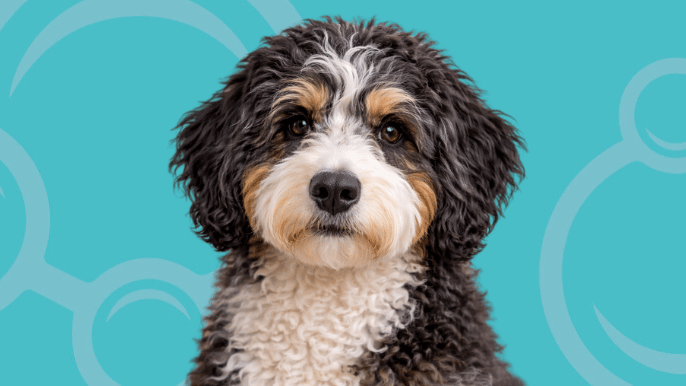
The Bernedoodle F1B typically wears a Curly Wavy Coat as classified in the FurHQ seven-coat system. The backcross to Poodle produces more consistent curl than the F1, typically with a defined, Poodle-like curl pattern.
The F1B coat is generally tighter, curlier, and lower-shedding than the F1. The Poodle-dominant genetics produce a coat that traps shed hair effectively, making it more allergy-friendly but also more prone to matting at the skin. The tricolour patterns may still appear but are often less pronounced than the F1.
The Long-Pinned Slicker Brush penetrates the tighter curls to reach the skin. The FurHQ Detail Comb verifies every brushed section.
The recommended kit is the FurHQ Starter Grooming Kit: Curly Wavy Coat.
Not Sure About Your Dog's Coat Type?
Not every dog fits neatly into one coat category, and that is completely normal. This is especially true for backcross doodles where coat texture can still vary. Use the FurHQ AI Coat Identifier to find out your dog's coat type and get matched to the right FurHQ Starter Grooming Kit. Simply upload a photo and receive an accurate classification with a personalised kit recommendation.
Puppy Coat to Adult Coat Transition
Bernedoodle F1B puppies experience a critical coat transition between 6 and 14 months. The softer puppy coat sheds into the developing adult curl, and the interlocking textures create severe matting potential. Daily brushing during this period is essential and non-negotiable. The tighter curl of the F1B can make this transition more mat-prone than the wavier F1.
Bernedoodle F1B Temperament during this period is cooperative and responsive when habituation started from puppyhood. Start early. A shorter trim during transition makes management significantly easier. Use Pawfect Finish Coat Spray at every session. The FurHQ 5-Step Grooming Method provides structure for managing the transition.
The FurHQ 5-Step Grooming Method: Technical Reality
The FurHQ 5-Step Method (Audit, Prep, Bath, Dry, Finish) applies to this coat type with emphasis on consistent mat prevention and thorough comb verification after every grooming session.
Learn the Method. Follow the Protocol. Complete the Mission.
Setup and Stability
Secure the dog using the Stay Put System (suction cup anchor + safety lead). For anxious dogs, the Hush Pup Wrap provides calming compression that helps them settle into a cooperative grooming state.
Tools and Technique
Audit: Begin every session with a full hands-on health check. Run your hands over the entire body feeling for lumps, bumps, and skin changes. Check nail condition and length. For breeds prone to dental issues, check the teeth and gums. Check inside the ears for redness, odour, or buildup. Then assess coat condition, parting the coat to feel for mats at the skin level. Focus on behind the ears, armpits, groin, collar area, and anywhere friction occurs. Curly coats hide mats completely while looking fine on the surface.
Prep: Brush through the coat to remove loose tangles before the bath. Mist with Pawfect Finish Coat Spray before any tool touches the coat. Never brush a curly wavy coat dry. Use the Long-Pinned Slicker Brush to work through any areas of resistance identified during the Audit.
Bath: Use Rubber Curry during bathing for skin stimulation and to help work shampoo to the skin. Rinse thoroughly.
Dry: Towel dry and use a dryer with a brush-through as the coat dries. Check density as you go. The coat should be dried thoroughly to the skin to prevent mildew and skin issues.
Finish: This is where the detailed tool work happens. Use the Long-Pinned Slicker Brush to work through the entire coat section by section. Follow every section with the FurHQ Detail Comb to verify brushing has reached the skin. If the comb catches, go back to the slicker. Slicker first, comb always. Apply Pawfect Finish Coat Spray for moisture, slip, and protection.
Chemistry and Coat Care
Texture-Tastic Shampoo is formulated for curly wavy coats, cleansing thoroughly while maintaining curl definition and texture. Coat-Quench Conditioner provides essential slip for the tangle-prone coat, reducing friction during brushing and preventing breakage. Pawfect Finish Coat Spray is a natural formulation that protects, nourishes, and conditions the hair, leaving it soft, shiny.
On curly wavy coats, it serves as a brushing spray that makes dry or wet combing a breeze, an anti-static spray that controls frizz and flyaway hair, and a leave-in conditioner that facilitates detangling. It also repels dirt, decreases drying times, and keeps the coat fresh between full grooming sessions.
FurHQ Starter Kit Breakdown
The FurHQ Starter Grooming Kit: Curly Wavy Coat contains 9 items:
Coat-Specific Items (4):
- Texture-Tastic Shampoo: Cleans while maintaining curly wavy coat texture
- Coat-Quench Conditioner: Essential slip and moisture for tangle prevention
- Long-Pinned Slicker Brush: Penetrates curly wavy texture to reach skin level
- FurHQ Detail Comb: Critical comb test verification after every brushing section
Standard Items (5, included in every kit):
- Stay Put System (suction cup anchor + safety lead)
- Hush Pup Wrap
- Rubber Curry (for bathing and dry brushing/skin stimulation)
- Ear Wipes
- Pawfect Finish Coat Spray
Bernedoodles don’t shed hair out - they hold it in. Routine line brushing keeps the coat soft instead of solid.
Bernedoodle F1B Temperament: Superpowers and Kryptonite
Superpowers
🌟 More consistent coat: Bernedoodle F1B Temperament comes with a more predictable curl pattern and lower shedding than the F1.
🌟 Balanced temperament: Combines Bernese gentleness with Poodle responsiveness, creating an engaged yet calm companion.
🌟 Enhanced trainability: The increased Poodle influence makes the F1B more responsive and quicker to learn than the F1.
🌟 Lower shedding: The tighter curl traps shed hair more effectively, benefitting allergy-sensitive households.
🌟 Gentle family nature: Bernedoodle F1B Temperament retains the patient, child-friendly devotion of the Bernedoodle cross.
🌟 Striking appearance: The curly coat with Bernese-influenced colours creates a beautiful, eye-catching companion.
Kryptonite
⚠️ Tighter curl mats faster: The more Poodle-like curl creates denser matting at the skin. Comb verification is essential.
⚠️ Large body grooming time: Standard F1B Bernedoodles still require significant grooming sessions.
⚠️ Less Bernese temperament: The 75/25 ratio means less of the calm, mellow Bernese influence some owners prefer.
⚠️ Heat sensitivity: Bernedoodle F1B Temperament still inherits some Bernese heat intolerance.
⚠️ Critical coat transition: Daily brushing during 6 to 14 months is even more important with the tighter curl.
⚠️ Hidden mat formation: Surface coat looks fine while mats form at the skin. The comb test is the only verification.
FurHQ's Lifestyle Lens and Pro Insights
Both F1 and F1B Bernedoodles are regularly groomed, and the coat difference is noticeable. Bernedoodle F1B Temperament on the grooming table is slightly more responsive and engaged than the F1. The tighter curl makes brushing feel more efficient because the slicker grips the curl, but it also means mats that form at the skin are tighter and harder to remove. Prevention is everything.
The biggest misconception to correct is that the F1B is easier to groom because it sheds less. Lower shedding does not mean lower maintenance. The tighter curl traps everything: shed hair, debris, and moisture. Without consistent brushing and comb verification, the coat mats faster than the wavier F1. Bernedoodle F1B Temperament makes grooming cooperative, but the technique requirements are not reduced.
The F1B is the better choice for allergy-sensitive households and for owners who want more predictable coat texture. The F1 is the better choice for owners who prioritise the full Bernese temperament influence. Both require the same committed grooming approach.
The tighter curl of the F1B mats faster at the skin, so comb verification after every slicker section is even more critical than with the F1. Mist with Pawfect Finish Coat Spray, line brush with the Long-Pinned Slicker Brush, and verify immediately with the FurHQ Detail Comb.
Health and Lifespan: The FurHQ Touch Test
The Bernedoodle F1B typically lives 12 to 15 years for Miniature and 10 to 12 years for Standard. The increased Poodle genetics may slightly improve lifespan over the F1.
Regular grooming sessions serve as health assessments when you incorporate the FurHQ Touch Test. Bernedoodle F1B Temperament is cooperative during examinations.
Hip and elbow dysplasia remain concerns. The reduced Bernese genetics may lower cancer risk compared to the F1, but monitoring remains important. Eye conditions including progressive retinal atrophy and cataracts are concerns from both parent influences. Skin allergies can affect coat health. Bloat (GDV) is a concern in larger individuals. Addison's disease may be inherited from the Poodle lineage.
Every grooming session is a conversation with your dog's body. The FurHQ 5-Step Grooming Method builds that conversation into your routine.
Related Reading
- Dog Coat Types Explained: Complete Guide to All Seven Types
- How to Dry a Dog After a Bath
- Dog Grooming Desensitisation: Complete Guide
- Dog Grooming Brushes: A Complete Guide by Coat Type
- Bernedoodle Temperament and Grooming Considerations
- Goldendoodle F1B Temperament and Grooming Considerations
- Standard Poodle Temperament and Grooming Considerations
The Bottom Line
Bernedoodle F1B Temperament delivers the beloved Bernedoodle gentleness with more Poodle responsiveness, more consistent coat texture, and lower shedding in a refined backcross. The tighter curl mats faster than the wavier F1. The grooming commitment is not reduced by lower shedding. But the return is a companion that combines the best of Bernese loyalty with Poodle intelligence in a more predictable, more allergy-friendly package that is deeply rewarding for dedicated owners.
Within the FurHQ 5-Step, the Audit checks for hidden mats beneath the tighter curl. The Prep phase line brushes with Pawfect Finish Coat Spray and verifies every section with the FurHQ Detail Comb. The Bath phase uses Texture-Tastic Shampoo and Coat-Quench Conditioner on a fully prepped coat. The Dry phase uses a high-velocity dryer because air drying mats the curly texture. The Finish phase confirms the entire coat passes the comb test.
If you are ready for the commitment, the FurHQ Starter Grooming Kit: Curly Wavy Coat gives you every tool and product you need. You have a system that works.
Learn the Method. Follow the Protocol. Complete the Mission.
You got this. And we have got you. 🐾
Variation Clarity Statement
Every dog is an individual. The F1B designation (75% Poodle, 25% Bernese) produces more coat consistency than the F1 but variation still occurs. Coat ranges from tight curls to moderate waves. Size depends on whether Standard or Miniature lines were used. Some F1B individuals may retain more Bernese traits than expected. Always assess the coat in front of you.
If you are unsure about your dog's coat type, use the FurHQ AI Coat Identifier to get accurate identification and the right kit recommendation.
FAQs
What coat type does the Bernedoodle F1b have?
The Bernedoodle F1b typically has a Curly Wavy Coat in the FurHQ seven-coat system with more consistent curl than the F1. The seven coat types are Smooth Single Coat, Short Double Coat, Medium Plush Double Coat, Feathered Long Double Coat, Wire Coat, Curly Wavy Coat, and Drop Coat.
What is Bernedoodle F1B Temperament like?
Bernedoodle F1B Temperament is typically marked by intelligence, trainability, and loyalty. The increased Poodle genetics (75%) often result in dogs that are highly intelligent and trainable, while maintaining the Bernese devotion. They may be slightly more energetic and alert than F1 Bernedoodles.
What does F1B mean and why does it matter for grooming?
F1B means the dog is a backcross: an F1 Bernedoodle (50% Bernese, 50% Poodle) bred back to a Poodle, resulting in 75% Poodle and 25% Bernese genetics. This increased Poodle influence typically produces a curlier coat that sheds less. However, curlier coats mat more readily, so F1B Bernedoodles generally require more consistent grooming than F1 Bernedoodles. The trade-off is clear: less shedding means more grooming time.
How often should I brush my Bernedoodle F1B?
The Bernedoodle F1b typically has a Curly Wavy Coat in the FurHQ seven-coat system with more consistent curl than the F1. The seven coat types are Smooth Single Coat, Short Double Coat, Medium Plush Double Coat, Feathered Long Double Coat, Wire Coat, Curly Wavy Coat, and Drop Coat.
Do Bernedoodle F1Bs shed less than F1 Bernedoodles?
Typically yes. The increased Poodle genetics in F1B Bernedoodles usually result in curlier coats that shed less than F1 Bernedoodles. However, the trade-off is that the curlier coat requires more consistent grooming to prevent matting.
Are Bernedoodle F1Bs hypoallergenic?
The tighter curl traps shed hair and dander more effectively than the F1, reducing airborne allergens. No cross is truly hypoallergenic. Bernedoodle F1b Temperament and coat are more allergy-friendly than the F1 but not guaranteed.
How long do Bernedoodle F1Bs live?
Bernedoodle F1Bs typically live 12 to 15 years for Standard sizes, potentially longer for Miniatures. Regular grooming sessions provide opportunity for the Touch Test to monitor health.
Is an F1B Bernedoodle right for first time dog owners?
Bernedoodle F1Bs can be challenging for first time owners due to their significant grooming requirements. While their intelligent temperament is trainable, the curly coat demands consistent, proper maintenance that first time owners may underestimate.
Why is the coat transition harder for F1B Bernedoodles?
The coat transition (6 to 14 months) is particularly challenging for F1B Bernedoodles because the curly adult coat traps the shedding puppy coat very effectively, creating severe matting potential. Daily brushing during this period is absolutely essential.
What health problems do Bernedoodle F1Bs have?
Bernedoodle F1Bs may inherit health issues from either parent breed, including hip dysplasia, elbow dysplasia, eye problems, heart conditions, and Von Willebrand's disease. The curly coat can hide developing issues, making regular hands-on examination essential. The Touch Test helps monitor for changes.
Do Bernedoodle F1Bs have the tri-colour pattern?
Bernedoodle F1Bs may display the tri-colour pattern (black, white, rust), but it is less predictable than in F1 Bernedoodles. The increased Poodle genetics mean coat colour is more variable. Bi-colour, phantom, and solid colours also occur.
How often should a Bernedoodle F1B see a professional groomer?
Bernedoodle F1Bs should see a professional groomer every 4 to 6 weeks. During the coat transition period (6 to 14 months), every 3 to 4 weeks is recommended. Professional grooming is particularly important for curly coats.
Is the F1b easier to groom than the F1?
No. Bernedoodle F1b comes with a tighter curl that mats faster at the skin. Lower shedding does not mean lower maintenance. The grooming technique and time commitment are the same.
How does Bernedoodle F1b Temperament differ from the F1?
Bernedoodle F1b Temperament has more Poodle influence: slightly more energy, more responsiveness, and more trainability. The Bernese calm and loyalty remain but are less dominant.
How often should I bathe my Bernedoodle F1b?
Bathe every 4 to 6 weeks using Texture-Tastic Shampoo followed by Coat-Quench Conditioner. Never bathe a matted coat. Dry thoroughly.
What is the difference between F1, F1b, and F2 Bernedoodles?
F1 is Bernese x Poodle (50/50). F1b is F1 Bernedoodle x Poodle (75% Poodle). F2 is F1 x F1 (most variable). Bernedoodle F1b Temperament has the most Poodle influence and the most consistent coat.
What tools and products are in the FurHQ Starter Grooming Kit: Curly Wavy Coat?
The FurHQ Starter Grooming Kit: Curly Wavy Coat contains 9 items. Coat-specific items: Texture-Tastic Shampoo, Coat-Quench Conditioner, Long-Pinned Slicker Brush, and FurHQ Detail Comb. Standard items: Stay Put System, Zen Wrap, Rubber Curry, Ear Wipes, and Pawfect Finish Coat Spray.
Should I choose an F1 or F1b Bernedoodle?
Choose the F1b for lower shedding, more coat consistency, and more Poodle responsiveness. Choose the F1 for more Bernese temperament influence and the classic calm, mellow Bernedoodle personality. Both require the same grooming commitment.
How does the FurHQ 5-Step Method work for the Bernedoodle F1b?
The FurHQ 5-Step Method (Audit, Prep, Bath, Dry, Finish) follows the same systematic approach as the F1 with extra comb verification for the tighter curl. Audit checks for mats and health changes. Prep mists with Pawfect Finish Coat Spray, line brushes with the Long-Pinned Slicker Brush, and verifies every section with the FurHQ Detail Comb. Bath uses Texture-Tastic Shampoo and Coat-Quench Conditioner. Dry thoroughly. Finish applies Pawfect Finish Coat Spray.
What FurHQ Starter Grooming Kits are available?
FurHQ offers seven coat-specific kits: FurHQ Starter Grooming Kit: Smooth Single Coat, FurHQ Starter Grooming Kit: Short Double Coat, FurHQ Starter Grooming Kit: Medium Plush Double Coat, FurHQ Starter Grooming Kit: Feathered Long Double Coat, FurHQ Starter Grooming Kit: Wire Coat, FurHQ Starter Grooming Kit: Curly Wavy Coat, and FurHQ Starter Grooming Kit: Drop Coat. Use the FurHQ AI Coat Identifier for accurate classification or visit the FurHQ Store.